

The Truth About Credit Cards - Part One

truth-credit-cards

I’m going to make some of you mad. That’s okay, I’ve done it before. HA! I’ve long been a proponent of using cash instead of using credit cards. I’m not very fond of plastic – I really only use my debit card to buy gas and to pay for things online. I don’t even have a credit card anymore - period. Am I afraid to carry cash? No. On a good day, a robber might get $300 from me. I usually only have $50 or less on hand, so I suspect I’m not a very attractive target.

Today I want to spend some time debunking several credit card myths – lies you’ve been told from the credit card industry (or your FAMILY). It is not true that you NEED a credit card to live. The only reason you need to establish credit is so that you can BORROW MORE MONEY! Is that really where you want to be?

Myth 1: I need a credit card for an emergency.

You do not need a credit card for emergencies…you need an emergency fund. Studies show that if you have that credit card, you’re going to use it. Also, you’ll spend more. Having a cash emergency fund causes you to be a bit more creative (aka – cheap) when it comes to dealing with “emergencies.” If your water heater goes out, you might buy a NEW one with a credit card…but if you were paying cash, you might ask if there was a scratch and dent available…or GASP, a used model.

Myth 2: I deserve it.

You what? You deserve what? If God gave us what we DESERVED we’d be in ROUGH shape. You don’t deserve much of anything. Work hard for it. Pay cash. When you can pay for it is when you deserve it. End of story.

Myth 3: The rewards are too good to pass up!

Play with this myth and you will lose. Credit card companies are multi-billion dollar businesses. These rewards won’t make you rich but one slip-up and you could be in a mess. You can do without those “rewards.” And if you don’t think that’s enough of an argument, how about switching to a debit card that also offers rewards – like Perk Street?

Myth 4: I can afford it.

Can you pay for that all at one time? No? Then you can’t afford it. Society has bought into the belief that being able to afford the payments is the same thing as being able to afford to buy, buy, buy. If you’re making payments, you really couldn’t afford it. End of story. Use cash…oh wait, did I already say that?

Myth 5: I pay it off every month.

Good for you. Then why are you using a credit card? Using a credit card causes you to spend more. It’s a fact. So, you’re spending more needlessly. I talk to so many people who have this mindset. Then they lose their job, get sick, or something unforeseen happens. BAM! They can no longer pay that card off. So the amount owed grows – the fees and penalties add up. I worked in the credit card industry and saw this all the time.

If this post made you mad, be sure to come back tomorrow for another. ;0)

Permanent link to this article: http://www.debtortobetter.com/the-truth-about-credit-cards-part-one/

Letters From Your Future Self

As we begin a new year, I thought it might be fun to read a letter from your potential “future self.” If you could write yourself a letter and send it ten years back in time, what would you write? What critical information would you give yourself in 300 words or less? With that challenge in mind, I’m going to let you see what your “future self” could be writing for you to receive today.

Option 1:

Dear 2013 {insert your name here},

Greetings from 2023! I’m so glad you made some good choices over the past ten years. They really paid off. Since I’ve only got 300 words, I’ll be brief. Because you stopped using credit cards and started living on a budget, your house was paid for in ’19 and you’re planning an awesome family vacation this year – Hawaii here you come. The car you thought about replacing in 2013 finally died in ‘16, but by then you’d saved up enough cash to buy something outright. It’s a good thing you did.

Even though you don’t want to read this part, I figure I’d better tell you that you’re going to be laid off in a few months. But don’t worry - there is something better waiting and it all works out – trust me. Your emergency fund sure came in handy. It kept the bills paid and food on the table.

Your kids are doing great. The time you were job hunting after the layoff allowed you to really spend some time pouring into them. They still talk about how great it was having you at home with them. Your wife still talks about it, too. You really showed her how committed you were to taking care of your family and she fell in love with you all over again.

Thanks you for having some discipline and being man enough to lead your family, even if it wasn’t (sadly, still isn’t) the popular thing to do. Even with the mistakes you made along the way, you did a great job.

Sincerely,

2023 {insert your name here}

Option 2:

Dear 2013 {insert your name here},

2023 is not what I hoped. You survived intact, but things aren’t nearly what they should be. You should have listened to that weird guy who kept telling you to get out of debt. You should have read his book in 2013 instead of waiting until after everything went wrong. Instead, you laughed at him for saying credit cards were dangerous and went about your life. That was all good until your boss came in and told you they had to let you go due to budget cuts. That new car you’d bought a few months earlier because you “needed” it got repo’d because you couldn’t keep up with the payments. You were able to keep the house and avoid bankruptcy, but only because some family helped you out. I sure wish you would have saved some money. Please, put some money away for a rainy day and cut up those stupid credit cards! It will save you so much heartache. I will give you some credit (pun intended), though. When you were at home after the layoff, you really got to spend some time with the kids. They still talk about how great it was. You were sad for a while, but then you realized the only way to make it better was to get your life back on track. We finally made it back to a good place where you could say things were better than before we lost it all after the layoff, but it sure took a while. Don’t give up – I promise these ten years are going to be hard, but you’ll make it.

Sincerely,

2023 {insert your name here}

Which would you rather read? Look back ten years and consider which would be closer to the letter you’d be writing and remember this: small choices today may mean a lot tomorrow. If you aren’t making progress toward the goals you want, pick a new direction. Set new goals, develop new habits and make things better.


Permanent link to this article: http://www.debtortobetter.com/letters-from-your-future-self/

Happy Day AFTER Christmas

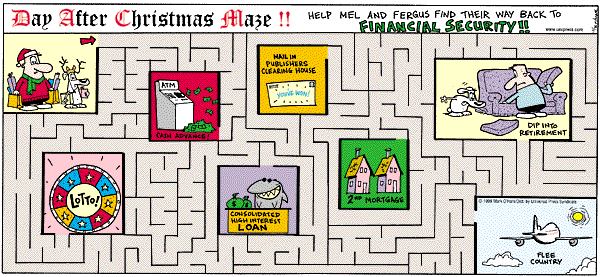
Hey everyone! I know this month was probably pretty tough for most of your bank accounts. With all the lovely gifts you gave to friends, family, co-workers, charitable organizations, your mail man, church members, servers at the local restaurants, random strangers, the paper boy, your hair stylist, your pastor, the neighbors, that ugly punk kid your son/daughter asked to bring home so you could approve of their potential relationship (the outcome: no approval granted), etc. We’ve all been there. December is a huge budget-buster. But in light of the fact Christmas was yesterday and credit card companies love January, I thought I’d share a couple of thoughts that may be useful.

First, I ran across this cartoon and thought it summarized the thought processes of a lot of Americans this time of year. Hopefully not you! Feel free to print and plan your “escape” from the bills.

day after Christmas

Second, I want to point you toward a post I wrote for my lovely wife’s website last year in the “Ask Barry” series we did about how to love the day after Christmas. If your budget took a big hit this month, take heart! There is hope.

To be honest, 2012 has been one of the worst and best years of my life. With the release of my book, the quick sale of our townhouse and my wife’s pregnancy with our second child, I was sure 2012 was going to rock. Then with the severe injury of my brother-in-law and the death of my dad, we’ve seen our share of tough stuff. With the birth of our son and the debt-free purchase of our new home, we recognized that God didn’t want us to finish off this year without plenty of blessings. So on this day after the celebration of Jesus’s birth, I want to remind you that no matter the circumstance you’re in and no matter how much or little you believe your existence matters, each day of life should be cherished and appreciated as the gift from God it is. So even though the gifts have all been opened and the traditional Christmas feast may now only be leftovers, today is a brand new day to recognize how much you should be thankful for. I wish you the absolute best in 2013 and look forward to continuing this journey with you for years to come.

Permanent link to this article: http://www.debtortobetter.com/happy-day-after-christmas/

Common Sense Taxes: How Long You Should Keep Records

Especially as we get near the end of the year and into tax season, the question always comes up of what records you should keep and which ones can go away. In our “paperless society” (ha!), this is especially important because pretty much no one wants to keep a bunch of old files if they don’t need them.

The IRS has an opinion and yet I don’t really think it gives enough information for you and me. So today let’s cover our butts with the IRS (and anyone else) who might want some of that old paperwork.

First, let me give you some of my general tips for simplifying your record-keeping:

  1. Sign up for e-statements. Less paper, online delivery, online reporting (if needed).
  2. As much as possible, pay your bills online. If you want to “print” the confirmation, download something like CutePDF (free) to save a record of the confirmation of payment.
  3. Keep a simple filing system for everything else. I use an accordion binder with some basic categories for each of the major bills I might get. For example, I have one for health/dental insurance that combines all the different types of paperwork that might fall in there. Don’t have too many categories here.
  4. Once a year (usually in February or March) I review every paper bill/receipt/etc. in my files and weed out those I no longer need (more details below). What’s left should be everything I need to file taxes and hang on to for the IRS and anyone else.

With those basic tips, let’s discuss how long to keep everything.

  • Utility bills – keep the last one you paid. If the lights are on and water is running, you are probably safe.
  • Rebates – keep the paperwork until the rebate comes. It has saved me a few hundred dollars to keep that stuff for a while.
  • Warranty paperwork – keep until the warranty is expired or I no longer have the product.
  • Auto Repair – keep all paperwork until vehicle is sold. New buyers LOVE to see complete records on maintenance, etc.
  • Mortgage paperwork – keep the last bill you paid, along with any/all additional paperwork they send (except privacy notices and things like that). When we had a mortgage I put that stuff in my tax file each year JUST TO BE SAFE.
  • Credit Card or other similar bills - keep the last bill you paid and, when it is paid off for good, keep the last statement showing a zero balance.
  • Anything filed with taxes as income/expense – keep for at least eight years. Why? Because the IRS says to keep it for at least seven. Usually our tax package and a copy of the final returns ends up taking up no more room than a large mailing envelope. I keep eight of those envelopes in storage, then when a new one comes in, an old one comes out and is destroyed (usually burned).

There really isn’t more to it than that. For those of you who are pack rats…LET IT GO! For those of you who refuse to keep anything, shame on you! It will cost you money one day. In all seriousness, don’t let the concern over keeping these files stop you from making a simple plan for your files and implementing that plan TODAY.

Permanent link to this article: http://www.debtortobetter.com/how-long-you-should-keep-tax-records/

How to Budget If You Don’t Get a Steady Paycheck

Let me be honest – budgeting is a lot easier if you get a steady, consistent salary each month. You know what’s coming so you can plan with it more easily. For the rest of us, there is a bit of extra work to do. That isn’t an excuse to avoid budgeting! But without a crystal ball, how do you budget when you don’t have a steady salary? Let’s talk about the three major scenarios:

  1. I work on straight commission (or I own a business and only get paid when there’s a profit).
  2. I work on partial commission (or I own a business and base my salary partially on the business profits).
  3. I’m paid hourly and I work where there is an ongoing cycle of overtime and layoffs.

Even though all three of those situations are extremely different, the approach to budgeting is much the same. If you’re on a varied income, making sure you do this the right way will help you make the most of every penny that comes in. Here are the steps.

  1. Look at your past income and do a little forecasting. Gather your income information from the last 6-12 months and look for trends. Consider what those trends can tell you about your income going forward. If you think the answer is “nothing,” go back and look some more. If you run a business you must forecast sales, inventory levels, headcounts, etc., etc. Apply this same logic to your personal finances. Use this historical income information to set a baseline salary you believe you can bring in each month, using the low end of the numbers you forecasted. This won’t be perfect, but it is as good as you can do. Even if you’re not very good at it to start, practice will help you improve.
  2. Build up a good emergency fund. Despite your best efforts, there will likely be months where your income will fall short of your plans. For that reason, you need something to fall back on. During lean times, cut expenses to the bone and only touch your emergency fund if you truly can’t make it without it. But having that there as a hedge to financial disaster is a huge help.
  3. Do a budget every month. Every month is different, so don’t expect to do one budget and call it done. Your budget isn’t on stone tablets – it should be on a piece or two of paper (or even better yet, a calendar). This will force you to review the numbers every month, before the month begins, and make adjustments to make it work.
  4. Be diligent. You can’t expect to do a good budget if you aren’t keeping good records. Even if you don’t think it is any fun, it is worth it to keep good records. I promise you’ll thank me once you get through the painful chore of developing that habit.

Beyond those four steps, budgeting for inconsistent incomes is no different than for anyone else. Don’t get hung up on the perceived difficulty, because really the only difference is in dealing with the income side of things. So while your friends on salary may have it a bit easier, for you it really comes down to keeping good records and being realistic with your income expectations.

Permanent link to this article: http://www.debtortobetter.com/how-to-budget-if-you-dont-get-a-steady-paycheck/

Older posts «

» Newer posts